

There is a strange irony at the heart of Rolex.
The company that built much of its reputation supplying watches to explorers, divers, mountaineers, scientists and adventurers eventually became the world’s most recognisable luxury watch brand. Somewhere along the way, steel tool watches became status symbols, waiting lists became part of the ownership experience, and the simple act of checking the time somehow turned into a public declaration of success.
And yet, hidden among all the Submariners, Daytonas and GMT-Masters, there are two watches that seem almost completely indifferent to all that noise: the Explorer and the Explorer II.
Neither is particularly flashy. Neither appears desperate to impress anyone. There are no polished ceramic bezels, precious metals or diamonds. Their identities remain rooted in something increasingly unusual in modern luxury watchmaking: purpose.
That is precisely why collectors love them.
The funny thing is that, despite sharing a name, the Explorer and Explorer II are about as different as Liam and Noel Gallagher: closely related, impossible to confuse, and each seemingly convinced it is the superior sibling.
The Explorer: The Quiet Professional
If James Bond were an architect instead of a secret agent, he would probably wear an Explorer.
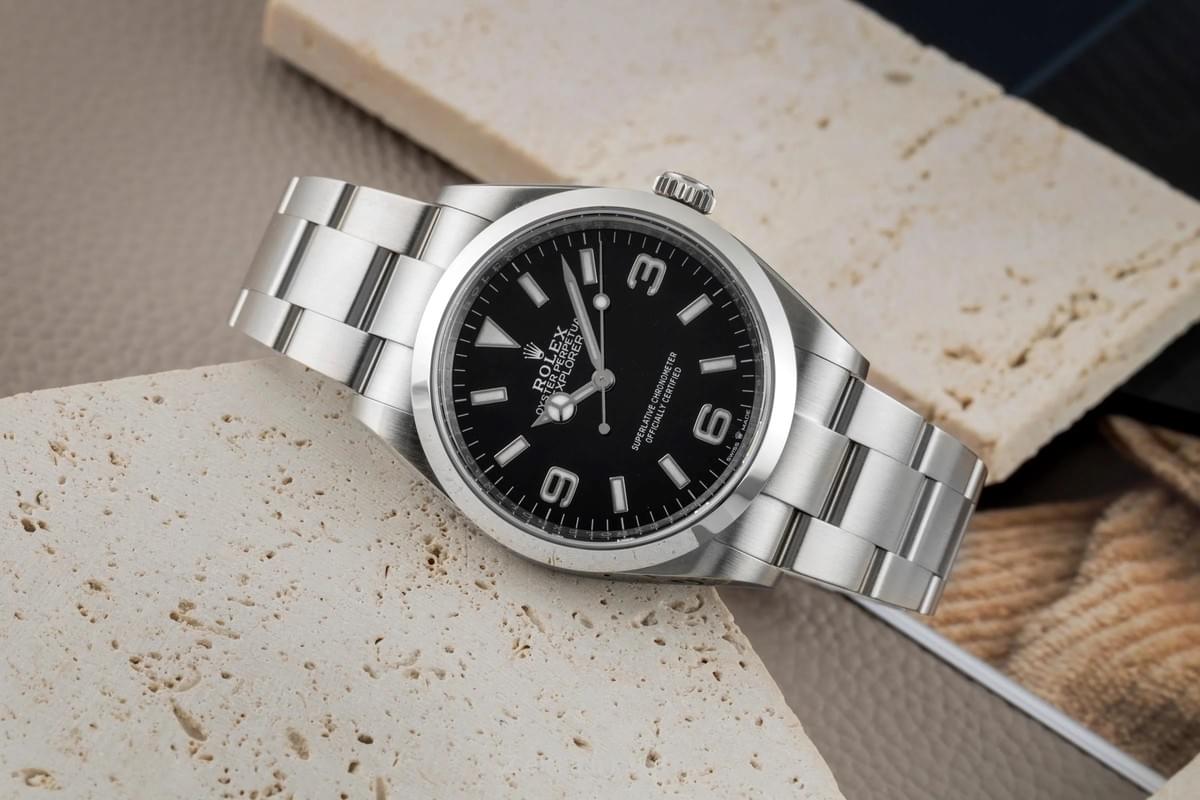
Everything about the watch is restrained.
Black dial. White markers. The legendary 3-6-9 numerals. No unnecessary decoration. No date window interrupting the symmetry. Nothing that does not absolutely need to be there.
The Explorer is the horological equivalent of a perfectly fitted white Oxford shirt. It is timeless precisely because nobody tried too hard to make it fashionable.
And that is also what makes it dangerous.
The more time you spend with the Explorer, the more you begin to appreciate its brilliance. At first glance, it can appear almost plain. Then you realise that Rolex has spent decades refining something most people would struggle to improve without ruining.
The proportions feel deliberate. Legibility is exceptional. It slips beneath a shirt cuff and looks equally at home on a mountain trail, in a boardroom or across the table at dinner.
This is a watch for someone who values subtlety.
Someone with nothing to prove.
Someone who would rather have another person notice the quality of the watch after six months than recognise it from across the room.
The Explorer does not enter the room before you do.
It waits patiently in the background.
And perhaps that is why it continues to occupy such an unusual place in the Rolex catalogue. In a brand whose crown has become one of the most instantly recognisable symbols of luxury on Earth, the Explorer remains remarkably uninterested in behaving like a luxury object.
The Explorer II: The Eccentric Sibling
Then there is the Explorer II.
The Explorer II feels as though somebody at Rolex looked at the original Explorer and said:
That’s all very nice. But what if we made it a little stranger?
Suddenly, the clean bezel was gone.
In its place came a fixed, engraved 24-hour bezel. An additional hand appeared on the dial. A date window entered the equation. Over subsequent generations, the watch evolved into something larger, bolder and considerably more assertive than its restrained sibling.
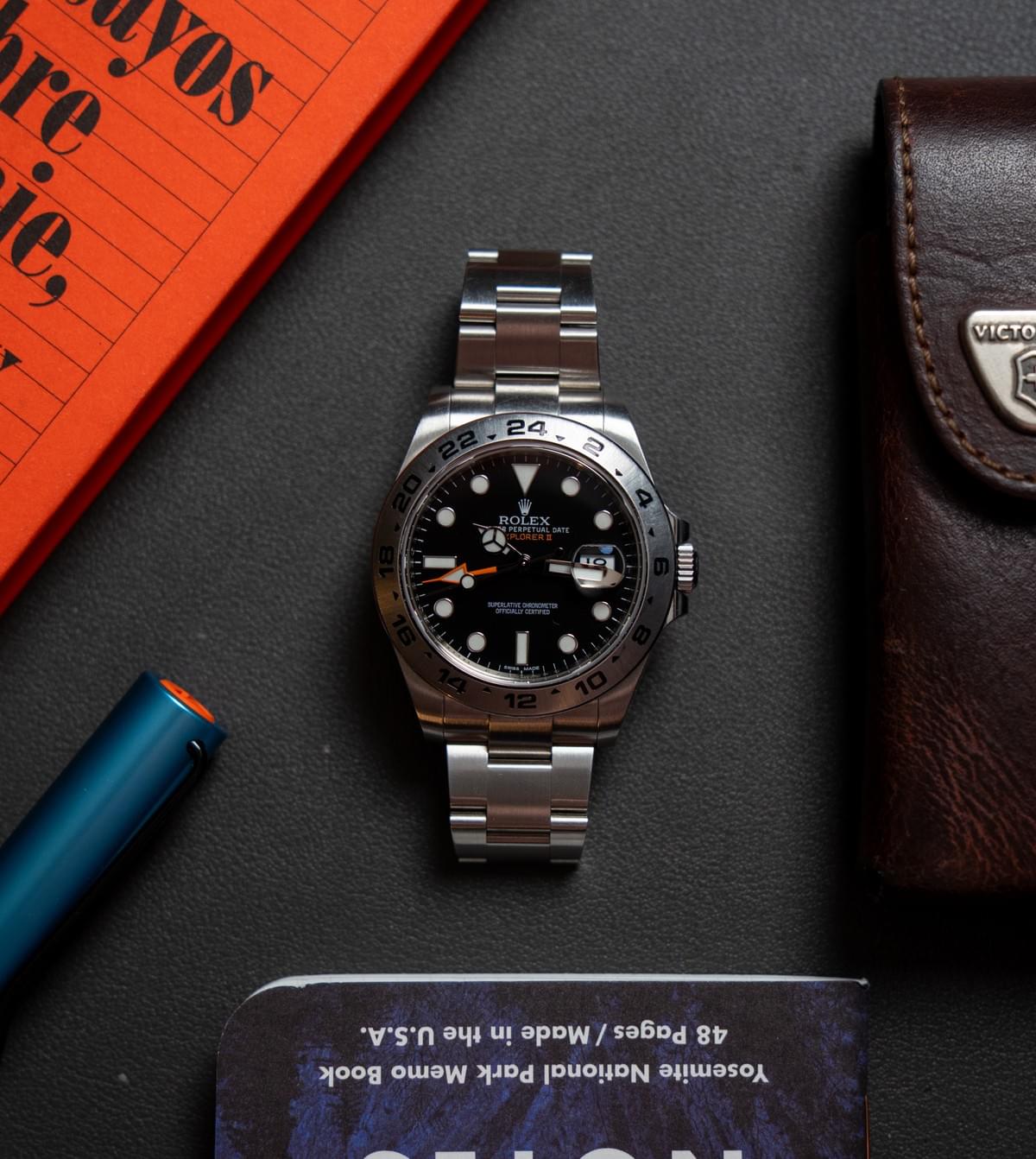
And the result was magnificent.
Introduced in 1971, the Explorer II was conceived with cave explorers and other environments where distinguishing day from night could become genuinely difficult in mind. Its 24-hour indication was not originally some romantic complication designed for crossing international time zones. It had a practical purpose: helping its wearer understand whether it was day or night when the sun itself could no longer provide the answer.
Think about that for a moment.
Rolex created a watch for people who might disappear underground long enough to lose track of daylight.
There is something wonderfully eccentric about that.
Most people buying an Explorer II today are unlikely to spend a week crawling through underground tunnels. Many will probably use its additional time-zone functionality while sitting in an airport lounge, waiting for an overpriced sandwich and a delayed flight.
But somehow, the spirit remains.
The Explorer II still feels like equipment.
And in an era when the distinction between luxury object and lifestyle accessory has become increasingly blurred, that matters.
Black Dial or Polar?
Every great rock band eventually produces an iconic album cover.
The Explorer II did something similar when Rolex gave it the white dial collectors now universally associate with the nickname “Polar.”
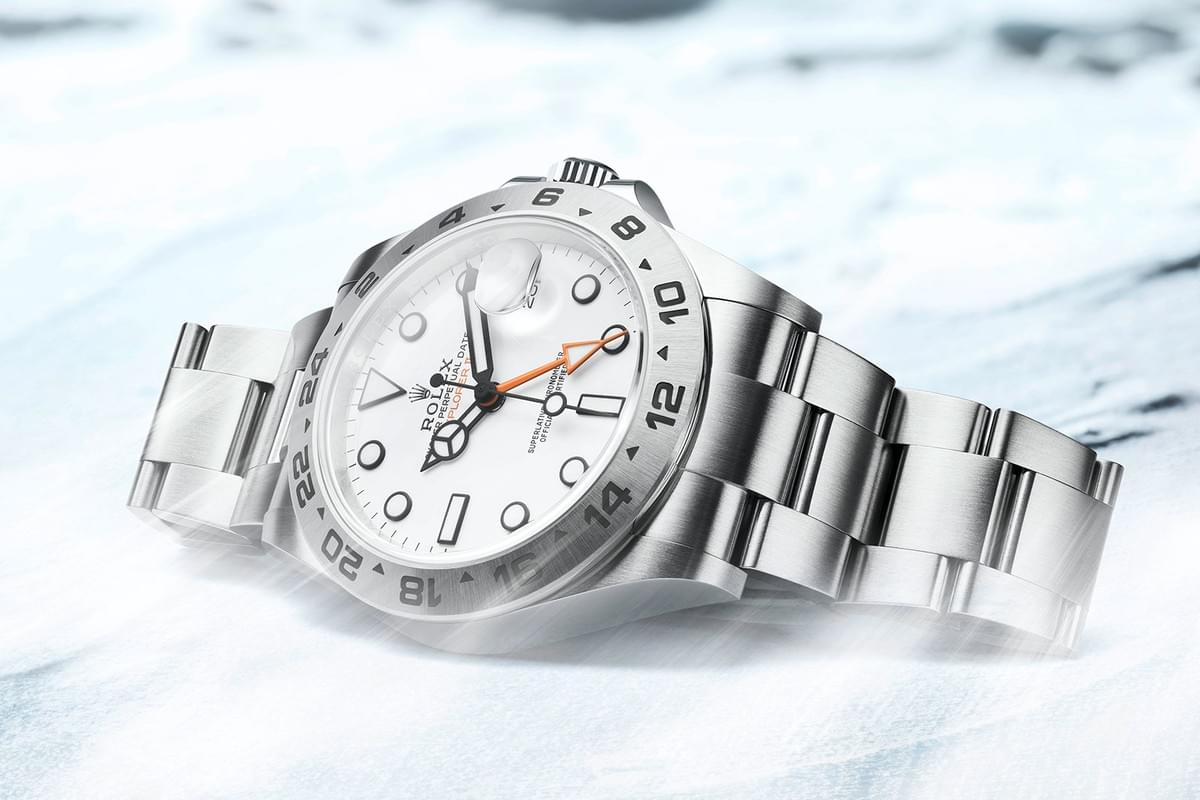
Against that stark white background, the black surrounds of the hands and hour markers seem almost to leap from the dial. Add the distinctive orange 24-hour hand of the modern generation and suddenly the Explorer II possesses a visual identity unlike almost anything else in the Rolex catalogue.
The black dial is arguably more discreet.
Perhaps even more versatile.
But the Polar is unforgettable.
It is a little louder.
A little bolder.
A little more confident.
And, crucially, it does not look like somebody bought a Rolex simply because they wanted people to know they bought a Rolex.
That distinction matters.
The Polar has character.
Not everyone will love it.
That may be part of the reason those who do tend to love it so much.
Two Explorers. Two Different Temperaments.
Choosing between these watches is less about specifications than personality.
The Explorer makes sense for someone who values discretion over recognition, proportion over presence and simplicity over complication. It may be one of the rare modern Rolex sports watches capable of almost disappearing on the wrist.
And for the right owner, that is precisely the attraction.
It works with almost anything. It refuses to shout. Its design does not rely on novelty because there is remarkably little about it that needs changing.
The Explorer II appeals to a different temperament.
It is larger, stranger and more overtly technical. Its additional time-zone functionality makes genuine sense for travellers, but its attraction goes beyond utility.
It remains one of the few Rolex sports watches that feels slightly outside the mainstream.
People who know watches recognise it immediately.
People who do not know watches may ignore it completely.
Oddly enough, that only makes its owners love it more.
One is almost anonymous elegance.
The other is unapologetically functional eccentricity.
Neither choice is wrong.
But they say very different things about the person wearing them.
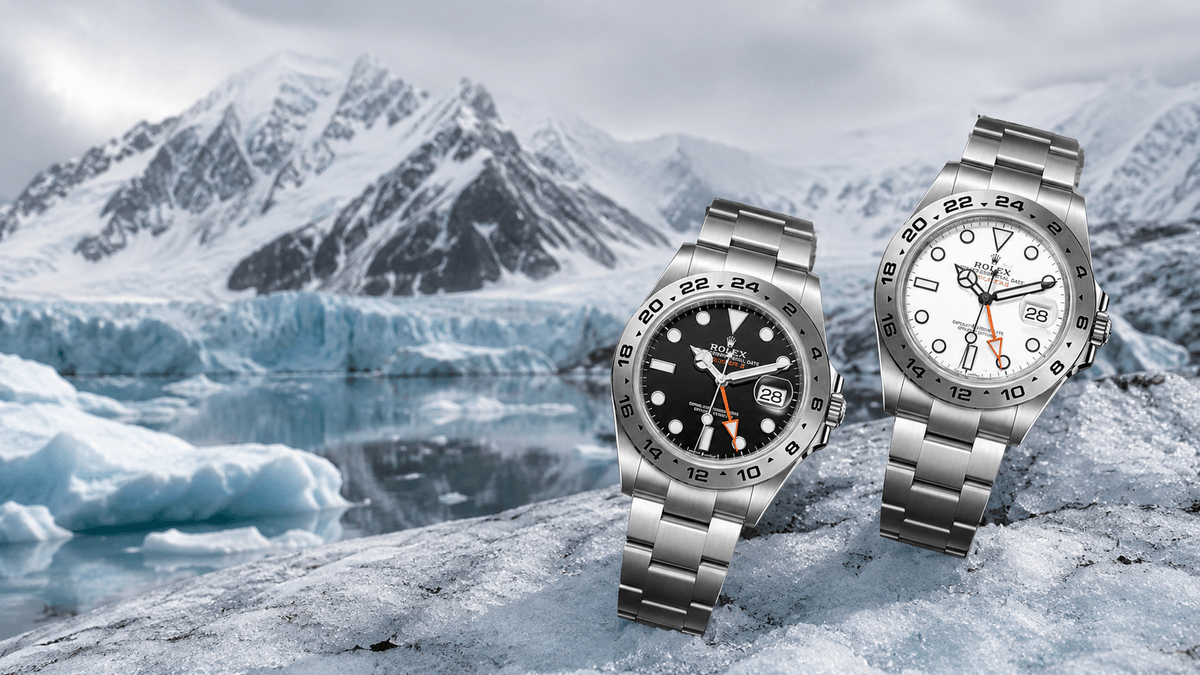
Why I Keep Coming Back to the Explorer II, as much as I admire the Explorer, my eyes remain fixed on the Explorer II. Perhaps it is because I spend so much time travelling, perhaps it is because I genuinely find the additional time-zone functionality useful or perhaps it is something less rational.
In an age of social media, endless product launches, speculative collecting and carefully manufactured exclusivity, the Explorer II feels refreshingly honest.
It feels less burdened by the investment narrative that surrounds so much of modern Rolex collecting. It does not carry the same speculative mythology as the Daytona, it does not possess the universal recognition of the Submariner, it lacks the jet-set glamour attached to the GMT-Master II, and somehow, that feels liberating.
Because underneath everything Rolex has become — the boutiques, the waiting lists, the secondary-market premiums, the celebrity wrists and the endless online arguments about availability — the Explorer II still looks like a piece of equipment.
A slightly strange one, admittedly.
But equipment nonetheless.
The Rolex Standing Outside the Spotlight
The Explorer II has always been the oddball.
And every great family has one.
The watch that never quite becomes the obvious choice. The one standing slightly outside the spotlight while everyone else fights over the Submariner, the Daytona and the GMT-Master II.
Perhaps that is precisely why I keep coming back to it.
Because there is an interesting contradiction in modern Rolex ownership.
For decades, Rolex built watches for people who went somewhere.
Today, increasingly, people go somewhere because they want others to see the Rolex they are wearing.
The Explorer II somehow seems to have escaped much of that transformation.
Its origins remain peculiar. Its design remains unmistakable. Its purpose is still visible in practically every element of the watch.
It does not need to be the most desirable Rolex.
Perhaps it is better that it isn't.
Because in a world increasingly obsessed with owning the Rolex everyone wants, there is something deeply appealing about choosing the Rolex not everyone understands.
The outsiders, after all, are often the ones worth remembering.
— Gus Scriffignano
European Editor, RAW TIME